
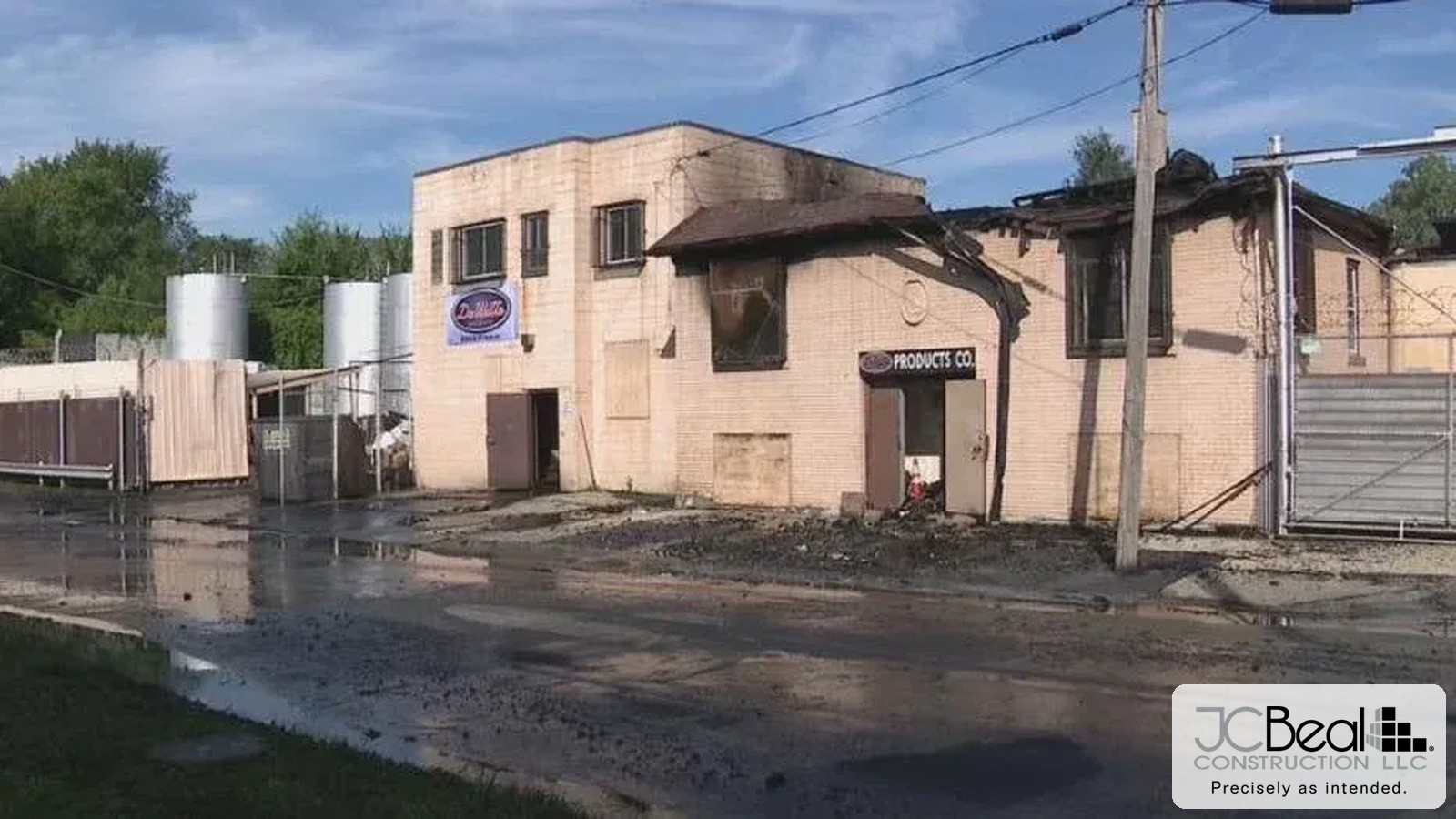
After the Fire: The First 10 Decisions a Commercial Building Owner Has to Get Right
A commercial fire is not one event. It is a chain of decisions that begins while the building is still wet and continues for months, and the ones made in the first week tend to set the ceiling on everything that follows. Owners rarely lose money because they chose the wrong tile. They lose it because a stabilization call was delayed, a scope was signed before it was understood, or nobody documented what the building looked like before the cleanup crews started moving material.
What follows is the sequence we walk through with institutions, commercial landlords, and multifamily owners across Detroit and Toledo after a loss. None of these decisions are exotic. All of them are reversible only at significant cost.
The First Days: Protecting What Is Left
1. Decide who is authorized to speak for the building
Within hours of the fire being knocked down, an owner will hear from restoration contractors, public adjusters, salvage companies, and often the media. Name one internal decision-maker and one outside representative before that happens. Every contractor who touches the building should route through that person. Losses go sideways when three parties each authorize work and nobody can later explain who ordered the demolition of a wall that the insurance carrier wanted to inspect.
2. Decide how quickly the building gets stabilized
Stabilization means board-up, temporary roofing, shoring of compromised structure, fencing, and securing utilities. It is not repair work — it is the work that prevents the second loss. An open roof in a Michigan November will do more cumulative damage over three weeks than the fire did in three hours, and most insurance policies obligate the owner to take reasonable steps to prevent further damage. Delay here can become a coverage argument later.
3. Decide to document the building before anyone cleans it
Photographs, video walkthroughs, drone imagery of the roof, and a written inventory of damaged contents should exist before a single dumpster is loaded. This documentation is the factual record every subsequent negotiation refers back to. For historic and older commercial buildings it does double duty: it captures original moldings, terra cotta, plaster profiles, and millwork configurations that will need to be replicated if they cannot be saved.
Money and Paperwork: Determining What Actually Gets Paid
4. Decide whether you understand your own policy before you negotiate it
Three provisions govern most commercial fire recoveries. Replacement cost value (RCV) pays what it costs to rebuild today; actual cash value (ACV) pays that amount minus depreciation, which on an eighty-year-old building can be a large subtraction. Ordinance or law coverage pays for the code upgrades a jurisdiction will require during the rebuild — sprinklers, egress, accessibility, energy code — that were not present in the original building. And business interruption coverage replaces lost rental or operating income during the restoration period, usually with a defined time limit. Owners who learn the difference between these after the adjuster's first offer are negotiating from behind.
5. Decide who prepares the estimate you will be judged against
The insurance carrier's adjuster will produce a scope and estimate. The owner is entitled to produce one as well, prepared by a contractor who has physically opened the walls. When those two documents disagree, the disagreement is resolved with line-item detail, not with volume. A contractor's estimate that itemizes selective demolition, hazardous material abatement, structural repair, and finish replacement gives the owner something to defend. A one-page lump sum gives them nothing.
6. Decide how the historic status of the building will be handled
If the property is listed on the National Register of Historic Places, sits in a local historic district, or may qualify for federal or state historic tax credits, that determination has to be made early — not after demolition. Restoration work on those buildings is reviewed against the Secretary of the Interior's Standards for Rehabilitation, typically through the State Historic Preservation Office (SHPO). Removing original material that could have been repaired can disqualify a project from credits worth twenty to forty-five percent of qualified rehabilitation expenses. That is a decision worth making with information rather than urgency.
Scope and Building: Determining What You Get Back
7. Decide what "restored" means for this building
There is a real difference between returning a building to its pre-loss condition, restoring it to its original historic appearance, and using the insurance settlement as the foundation of a broader repositioning — converting upper floors, upgrading systems, or reconfiguring tenant space while the building is already open. Each path has a different budget, schedule, and approval process. Choosing it deliberately in week two is far cheaper than discovering it in month five when the drywall is up.
8. Decide how smoke and water contamination will be remediated, not just cleaned
Fire damage is chemical as well as structural. Soot residue is acidic and continues to corrode metal, etch glass, and stain porous material for as long as it remains in place. Suppression water migrates into wall cavities, floor systems, and elevator pits, where microbial growth begins within roughly forty-eight to seventy-two hours. Ask specifically how the contractor will test and document indoor air quality (IAQ) and surface contamination, and confirm that technicians hold certification from the Institute of Inspection, Cleaning and Restoration Certification (IICRC). Odor that returns in humid weather six months after reopening is the signature of remediation that was cosmetic.
9. Decide how hazardous materials will be addressed
Any commercial building constructed before roughly 1980 should be assumed to contain asbestos in flooring, pipe insulation, plaster, or roofing, and lead in paint layers, until testing proves otherwise. Fire and the demolition that follows disturb both. Abatement is a licensed, separately permitted activity with its own schedule and cost, and discovering it mid-project stops the job. Testing during the assessment phase is inexpensive; testing after a crew has been working in the space for two weeks is a liability discussion.
Reopening: Determining How Fast Revenue Returns
10. Decide the sequence that gets tenants back in the building soonest
The fastest total schedule and the fastest return to revenue are rarely the same plan. If the fire was confined to two floors of a six-story building, a phased approach — restoring and reoccupying undamaged floors under a temporary or partial certificate of occupancy (CO) while work continues above — can restart rent months before final completion. That requires early coordination with the authority having jurisdiction (AHJ), the local building and fire officials who approve occupancy, and it requires a contractor comfortable working in an occupied building with separated life-safety systems. It also requires the owner to ask for it, because the default assumption on most projects is one continuous shutdown.
The Common Thread
Every decision on this list rewards information over speed and punishes improvisation. The owners who come out of a fire whole are not the ones who moved fastest — they are the ones who stabilized immediately, documented completely, and then took the time to understand the building, the policy, and the regulatory path before committing to a scope. For a historic or architecturally significant property, that discipline is what makes it possible to put the building back precisely as intended rather than merely making it functional again.
If your building has suffered a fire and you are working through these decisions now, connect with our team. We assess damage, document conditions for your carrier, and rebuild commercial and historic properties across Detroit, Toledo, and the surrounding region.