
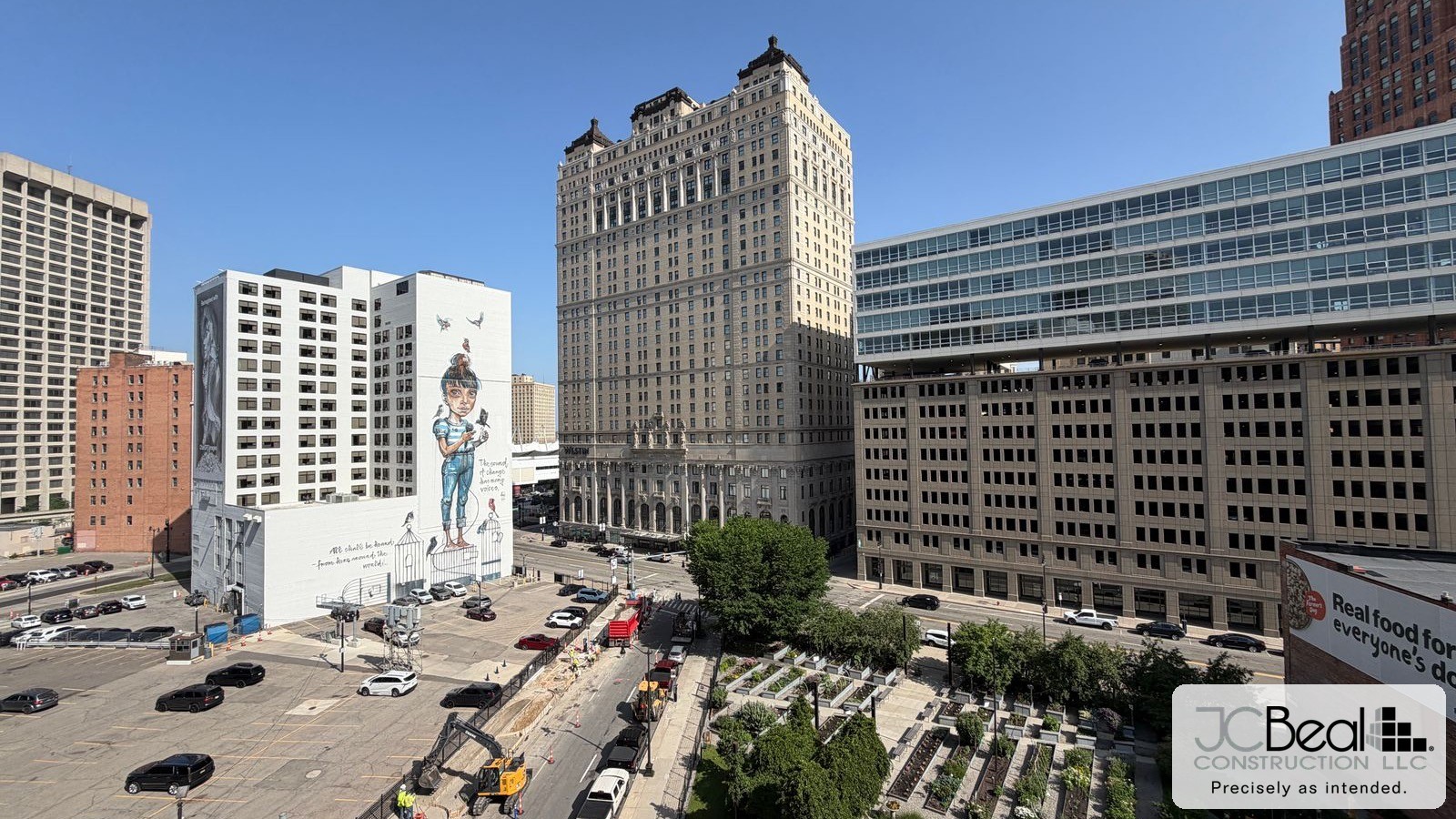
Detroit and Toledo's Restoration Renaissance: The Landmark Projects Signaling a Downtown Comeback
For thirty years, the story of downtown Detroit and downtown Toledo was told in vacancy rates. Grand buildings — the kind with limestone cornices, terra cotta detail, and lobbies built to impress — sat dark while the market moved to the suburbs. Owners boarded them up because the math never worked.
That math has changed. Across both cities in 2026, a remarkable number of landmark buildings are moving from "someday" to "under construction." Not one signature project carrying a whole district, but a cluster of them — enough that the pattern is no longer a coincidence. For institutions, commercial owners, and multifamily investors sitting on older buildings in either market, this is worth understanding, because it tells you something about what your own building may be worth restoring.
Detroit: The Projects Signaling the Turn
Lee Plaza. The Art Deco tower on West Grand Boulevard sat vacant for close to three decades and became, fairly or not, the photograph people used to illustrate Detroit's decline. Construction is now underway on its restoration, led by a partnership including the Roxbury Group, Ethos Development Partners, and Lighthouse. The completed building will deliver 117 units of affordable senior housing, with the first phase targeted for the fourth quarter of 2026. A building that spent thirty years as a symbol of loss is becoming housing.
The Belle at 1346 Broadway. Built in 1926 as the Broadway Exchange Building, this eleven-story property reopened this summer — exactly one hundred years after it first opened — as 42 apartments above two floors of commercial space, redeveloped by Bedrock. Century-old office buildings with deep floor plates are among the hardest properties to convert. This one got done.
Book Tower. The roughly $400 million adaptive reuse of Book Tower stands as one of the largest projects of its kind in Michigan, and it did something important for the market: it proved a restoration of that scale and complexity could actually be financed, executed, and leased.
Michigan Central Station. Ford's restoration of the station is already producing what developers call a halo effect on the western edge of downtown — the measurable tendency of one restored anchor to make the buildings around it financeable. Corktown property that could not attract capital ten years ago now competes for it.
Hudson's Detroit. On the site of the old Hudson's department store, General Motors formally opened its headquarters and showroom in the shorter of the two new buildings in January 2026, with the 45-story tower and its hotel following. This one is new construction rather than restoration, but it matters to restoration owners: it puts thousands of daily workers back within walking distance of exactly the kind of older, mid-block buildings that need foot traffic to pencil.
Toledo: A Quieter Version of the Same Pattern
Toledo's projects carry smaller price tags and less national press, but the underlying dynamic is identical.
The Four Corners Project. The Spitzer and Nicholas buildings at Huron and Madison have anchored — and, when empty, dragged down — the center of downtown Toledo for years. The Lucas County Land Bank has entered pre-development agreements with RKP Group, and interior demolition that began last fall has continued into 2026. The plan calls for roughly 400 apartments plus commercial office space. Four hundred residents at that intersection changes what every ground-floor storefront within a few blocks is worth.
317 N. Superior Street. The Dymarkowski Development Group is converting this five-story building in a $10.3 million project scheduled for completion in October 2026: 19 apartments, a tenant rooftop patio, a first-floor restaurant, and a Prohibition-era speakeasy in the basement. The capital stack is instructive — $75,000 in city grants and $1,460,939 in state historic tax credits alongside private money.
Riverview Tower and the Stein Building. In June 2026, Ohio announced its latest round of historic preservation tax credits: more than $86 million supporting 37 projects across 51 buildings statewide, expected to draw approximately $753 million in private investment. Toledo took two of them — a $3 million credit toward the $16 million Riverview Tower project and $1.86 million toward the $8 million Stein Building preservation.
What Is Actually Driving This
Restoration renaissances do not happen because sentiment shifts. They happen because three specific things line up.
Historic tax credits close the gap. A historic tax credit (HTC) is a dollar-for-dollar reduction in tax liability earned by rehabilitating a certified historic building. The federal credit is worth 20 percent of qualified rehabilitation expenditures, and both Michigan and Ohio operate state programs on top of it. Look at the Toledo numbers again: $1.46 million of state credit on a $10.3 million project, or $3 million on a $16 million project. That is frequently the difference between a deal that pencils and a deal that dies.
The credits come with rules. To qualify, work must satisfy the Secretary of the Interior's Standards for Rehabilitation — the federal criteria governing how a historic building may be altered. Original windows generally cannot simply be swapped for modern units. Distinctive materials must be repaired rather than replaced where repair is feasible. New additions must be differentiated from the old fabric. These standards are why restoration is not renovation, and why the wrong contractor decision in month two can disqualify a credit claimed in month twenty.
Anchors make neighbors financeable. Lenders underwrite comparable properties. One completed restoration on a block gives an appraiser something to point to, which lowers the perceived risk on the building next door. That is the mechanism turning individual projects into district-wide momentum in both cities right now.
What This Means If You Own One of These Buildings
If you hold an older commercial, institutional, or multifamily property in either market, the practical takeaways are straightforward.
- Get a real condition assessment before you get a pro forma. The variables that decide whether a historic rehabilitation succeeds — masonry condition, structural capacity, hazardous materials, the state of the building envelope — are discovered through investigation, not estimated from a spreadsheet.
- Establish tax credit eligibility early. Certification is sequential and unforgiving. Work performed before the right approvals are in hand can be excluded from qualified expenditures, and in some cases can jeopardize the credit entirely.
- Choose a builder who has worked inside the Standards. Restoring a historic facade, matching a discontinued profile, and documenting the work to a preservation reviewer's satisfaction are learned skills. General construction competence does not automatically transfer.
- Understand that phasing is a financing tool. Lee Plaza is being delivered in phases for a reason. Sequenced construction lets capital arrive in stages and lets a building begin generating revenue before the last floor is finished.
The Buildings Were Always Worth It
What is happening in Detroit and Toledo is not that these buildings suddenly became valuable. They were always valuable — irreplaceable, in the literal sense that nobody will ever again build a 1926 office tower with that craftsmanship at that cost. What changed is that the financing tools, the market demand, and the construction expertise finally arrived at the same time.
At JC Beal Construction, we have spent decades on exactly this work: civic landmarks, century-old commercial buildings, and fire and water damage restoration across Detroit and Toledo. The buildings tell you what they need. The job is to listen, and then to rebuild them precisely as intended.
If you own a historic property in either market and want to understand what restoration would actually require, connect with our team.