
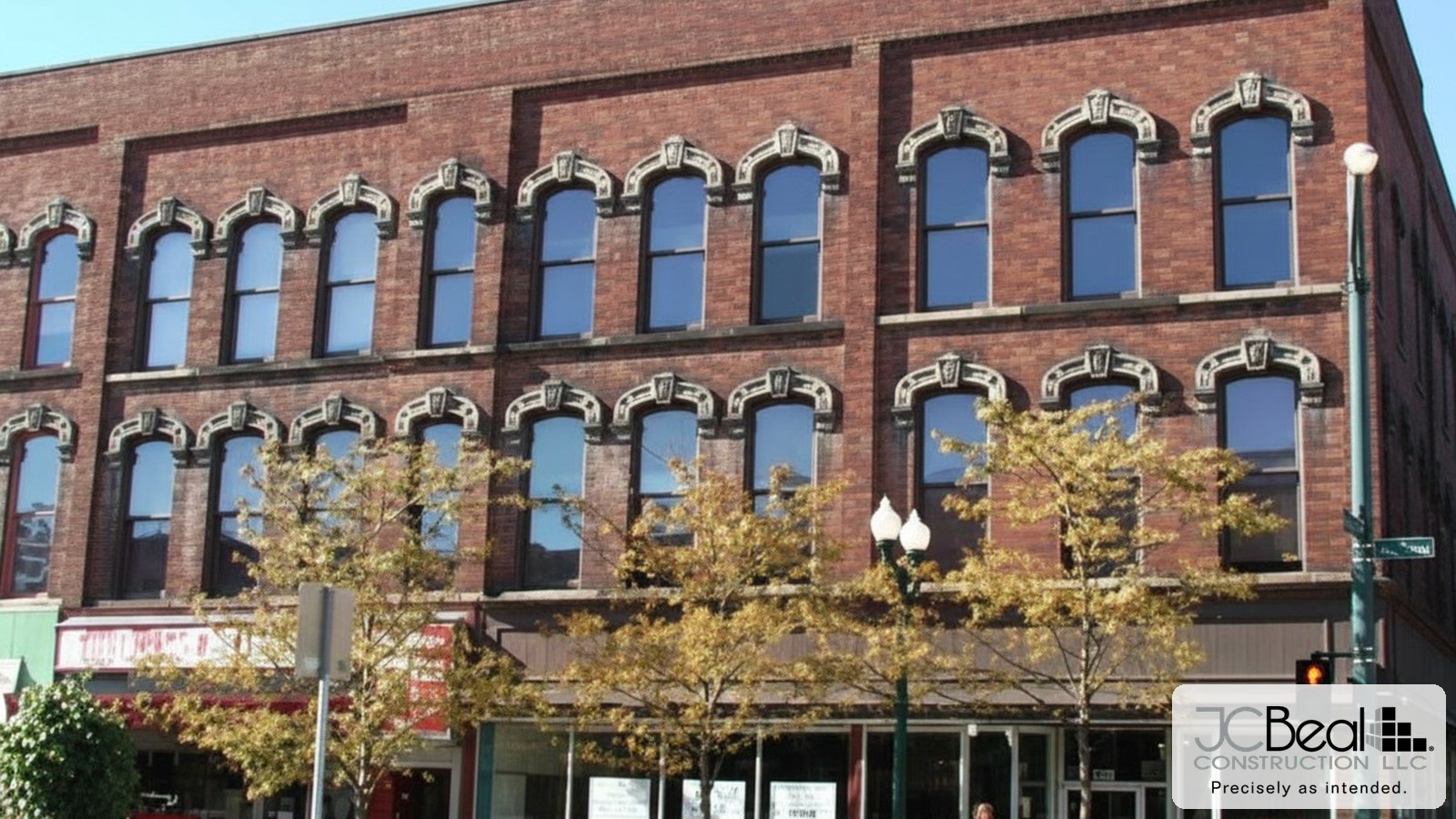
Downtown Revitalization Economics: What One Restored Anchor Building Does to a Main Street Block
Every struggling downtown has one: the building everyone points at. Six or eight stories of limestone and brick at the best corner on the block, dark above the second floor, with a bank of plywood where the storefront glass used to be. It has been called an eyesore in the local paper and a "redevelopment opportunity" in three separate planning studies. Nothing has happened.
Owners and institutions considering that building almost always evaluate it as a standalone deal — what it costs to restore, what it rents for, whether the two numbers meet. That is the right question, but it is not the whole question. A restored anchor building does not only produce its own income. It changes the economics of every parcel around it. Understanding how that works is what separates a project that pencils on paper from one that actually lifts a corridor.
What Makes a Building an "Anchor"
In downtown redevelopment, an anchor building is not simply the largest structure on the block. It is the building whose condition sets the perceived trajectory of the street. It usually has three characteristics:
- Position. It sits at a corner, a terminating view, or the intersection with the highest pedestrian and vehicle counts.
- Presence. It has architectural weight — a distinctive cornice, a tower, ornamental masonry, a scale that dominates its neighbors.
- Capacity. It holds enough square footage to bring meaningful daytime population to the block if it is occupied.
Because of those three things, the anchor is the building that visitors, tenants, and lenders read first. When it is boarded, the block reads as declining regardless of how many small businesses are quietly operating next door. When it is restored and lit, the block reads as recovering — again, regardless of what else has changed.
Five Ways One Restoration Moves a Whole Block
1. It resets the rent comparables
Commercial appraisals and lender underwriting rely on comparables — recent lease and sale transactions for similar space nearby, commonly shortened to "comps." On a distressed block, the comps are distressed. Every landlord negotiating a lease is negotiating against the last cheap deal signed down the street.
A restored anchor introduces a new set of transactions at a materially different rate, because restored space with modern mechanical, electrical, and plumbing systems inside a historically significant envelope commands a different tenant. Those leases become part of the comp set the next appraiser pulls. The neighboring owner who does nothing at all now has a better argument for asking rent — and, when they eventually refinance, a better supported valuation.
2. It converts vacancy into daytime population
Retail and restaurant tenants underwrite location on foot traffic during the hours they are open. A vacant 60,000-square-foot building contributes nothing. The same building restored to a mix of upper-floor apartments and ground-floor commercial space might introduce a few hundred people who are on that sidewalk daily, on a schedule, without a car trip.
That is the number a coffee shop operator, a pharmacy, or a service business actually needs before signing a ten-year lease. The anchor does not create demand for its neighbors by being attractive. It creates demand by producing a resident and worker base within walking distance of them.
3. It de-risks the next lender's underwriting
This is the least visible effect and often the most important. Lenders evaluating a downtown project are pricing uncertainty: whether the corridor is on the way up or the way down, whether the borrower's projections for lease-up are credible, whether a completed building will find tenants.
A finished restoration one door away answers several of those questions with evidence rather than argument. It proves that construction in a century-old structure in that specific market can be completed and delivered. It proves tenants will sign there. Financing that was unavailable to the second project on a block is frequently available to the fourth, and the anchor is what moves the block from the first category to the second.
4. It changes what public money can do
Most downtown revitalization involves some form of public participation — historic tax credits at the state or federal level, tax increment financing (TIF, where the increase in property tax revenue generated by a project helps repay its development costs), façade improvement grants administered by a Downtown Development Authority (DDA), or brownfield redevelopment incentives.
Nearly all of these tools work better with momentum. TIF in particular depends on rising assessed value within a defined district; a single large restoration raises the increment the district can capture, which funds the next round of public improvements — streetscape, lighting, parking, utilities. Those improvements then lower the cost and risk of the next private project. The anchor is what starts that cycle rather than a study that recommends starting it.
5. It stops deferred-maintenance contagion
Vacant buildings are not neutral neighbors. An unheated structure with a failed roof pushes water into shared party walls. Broken windows invite entry, and entry invites copper theft and fire. Failing masonry becomes a public-safety liability that can trigger a municipal condemnation order and, eventually, an emergency demolition that leaves a permanent hole in the streetwall.
Once one building on a block is demolished, the block loses continuity — the unbroken row of storefronts that makes a walkable commercial district function. Restoring the anchor removes the single largest source of that risk and protects the buildings physically attached to it.
A Way to Think About the Numbers
Consider a simplified example — the specifics vary widely by market, so treat this as a framework rather than a forecast.
An owner is evaluating a 40,000-square-foot 1920s commercial building. Underwritten as a standalone asset, restoration costs exceed what the stabilized net operating income (NOI — rental income after operating expenses, before debt service and taxes) will support at current block-level rents. On that math alone, the project does not proceed, which is precisely why the building has sat for two decades.
Now underwrite it honestly as an anchor. Historic tax credits reduce the equity required. A TIF arrangement covers a portion of site and infrastructure cost. The rents supportable in year three are not today's block comps but the comps the building itself will create. The neighboring parcels the same owner or a partner controls appreciate as a direct result of the restoration — value that never appears in a single-asset pro forma but is entirely real on the balance sheet.
The lesson is not that anchor projects are secretly cheap. They are not. The lesson is that evaluating one strictly as an isolated building will almost always produce a "no," and that answer is a modeling artifact rather than a market verdict.
Why Some Anchor Restorations Fail to Move Anything
Not every restored landmark lifts its block. The ones that do not usually share a few traits worth avoiding:
- The ground floor stays dark. Upper-floor residential with an empty or office-only street level produces almost none of the sidewalk effect. The first floor is where a block's economics live.
- The work is cosmetic. A cleaned façade over unaddressed structural, roofing, or envelope problems buys a few years and then the building is distressed again — with the added damage of having convinced the market that restoration does not last.
- The schedule never ends. A project in scaffolding for four years signals distress just as loudly as vacancy did. Predictable completion is part of the economic benefit, not a separate concern.
- The restoration erases what made it an anchor. Replacing original windows, ornament, and storefront configuration with generic modern assemblies removes the architectural presence that gave the building its influence in the first place — and typically disqualifies the project from the historic tax credits that made it feasible.
What Owners and Institutions Should Establish Before Committing
If you are weighing a downtown anchor project, the diligence that matters most tends to be construction diligence, not market diligence:
- What is actually behind the walls? Structural capacity, existing framing, hazardous materials such as lead paint and asbestos, and the true condition of the roof and masonry envelope determine most of the real cost. These need investigation before a budget is set, not discovery after.
- Does the team have historic experience specifically? Restoration is a different discipline from new construction. Matching historic masonry, repairing rather than replacing original windows, and meeting the Secretary of the Interior's Standards for Rehabilitation — the federal criteria that govern tax credit eligibility — require crews who have done that work before.
- Is the tax credit path protected in the construction documents? Credit eligibility is lost through field decisions, not policy decisions. The contractor has to understand which details are non-negotiable.
- Can the schedule be committed to, and phased if necessary? Partial occupancy of completed floors while work continues above can start revenue earlier and shorten the period during which the building signals uncertainty to the block.
The Larger Point
Downtown revitalization is often discussed as a matter of policy, branding, or public investment. In practice it is far more concrete than that. Corridors recover when specific buildings get restored, in a specific order, by teams capable of doing the work correctly the first time — and the anchor building is the one whose restoration makes everything after it easier to finance, lease, and justify.
That is why these projects deserve to be evaluated on what they do to a block, not just on what they return as a line item. And it is why the execution matters as much as the underwriting. A restoration that is completed on schedule, preserves what made the building significant, and brings the ground floor back to life is what turns one address into a corridor.
JC Beal Construction has spent generations restoring the buildings that anchor downtowns across Michigan and Ohio — civic halls, institutional landmarks, and historic commercial structures rebuilt precisely as intended. If you are evaluating an anchor property and need a realistic read on condition, cost, and schedule before you commit, connect with our team.