
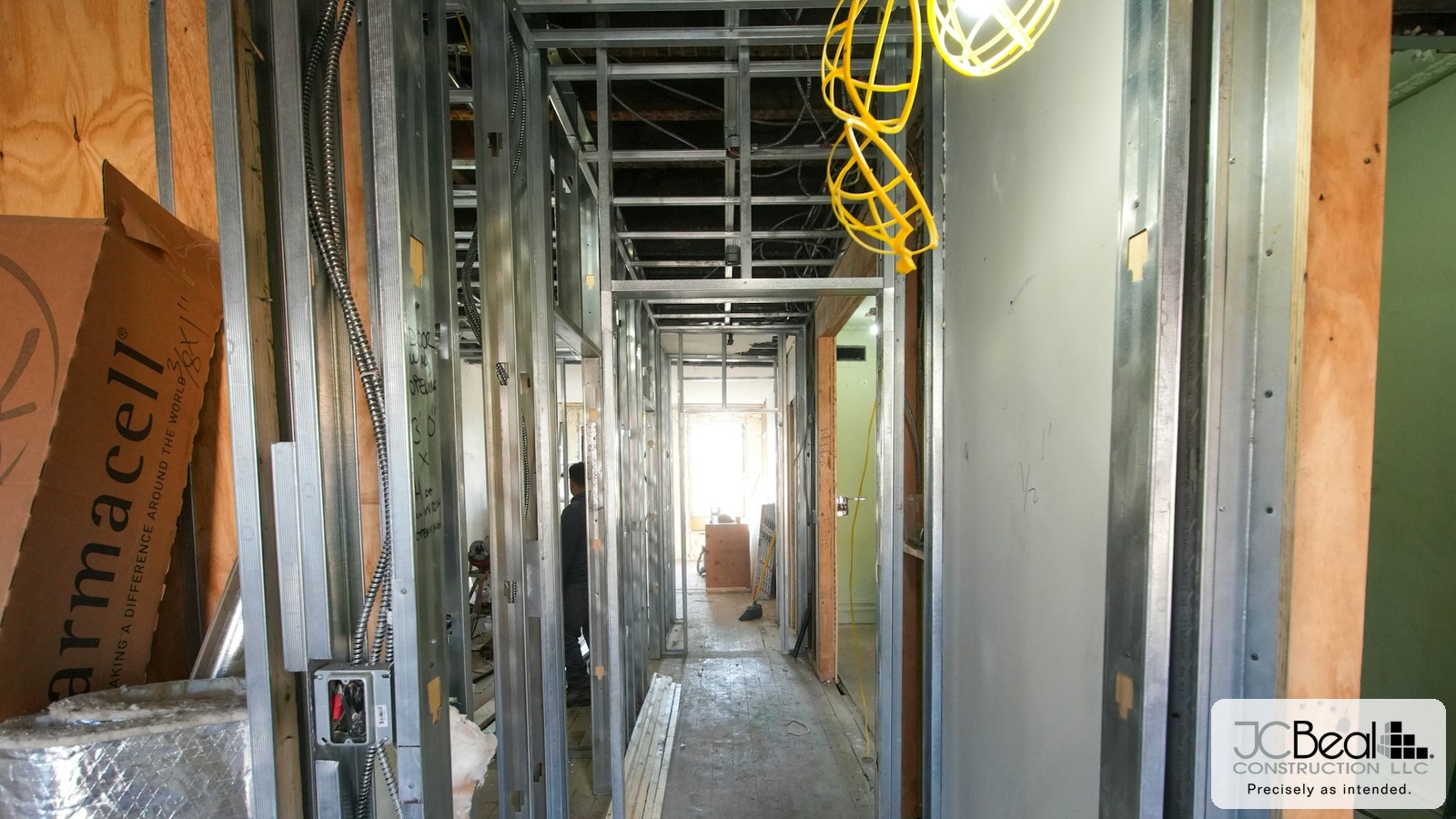
Phased Construction in Occupied Buildings: Keeping a Courthouse or Hospital Running During Restoration
A courthouse doesn't stop hearing cases because its façade needs repointing. A hospital doesn't close a wing because the roof above it is fifty years past its service life. For most of the buildings JC Beal Construction restores in Detroit and Toledo, the work has to happen while the building keeps doing its job — judges keep dockets, nurses keep rounds, and the public keeps walking through the front door. That constraint doesn't just complicate the schedule. It reshapes almost every decision a general contractor (GC) makes before the first wall comes down.
Why "Just Close It" Is Rarely the Real Option
Vacating a courthouse or hospital sounds simple until you price out the alternative. Relocating a circuit court means renting space, moving records and security infrastructure, and absorbing months of docket delay. Relocating even one hospital floor means finding licensed beds elsewhere in a market that doesn't have spare capacity, and it can trigger its own regulatory review. For most institutional owners, the honest math says the building has to stay open — which means the restoration has to be planned around continuous occupancy from day one, not treated as an inconvenience discovered mid-project.
Breaking the Building Into Zones the Institution Can Absorb
Phased construction means dividing a restoration into sequenced zones — a wing, a floor, a wing of a floor — sized to what the institution can operationally give up at any one time, rather than the size a contractor would prefer for efficiency. In a hospital, that sequencing is governed by an Infection Control Risk Assessment (ICRA), a formal review that dictates containment class, negative-air pressure, and dust control based on what's happening on the other side of the wall — an ICU has very different requirements than an administrative office. Courthouses have their own version of this logic: a zone containing an active courtroom or a records vault gets isolated and protected differently than an unoccupied basement level. The zone plan, not the drawings, is usually the document that determines how long the project actually takes.
The Daily Choreography Behind the Schedule
Once a building is broken into zones, the harder problem is coordinating people, materials, and noise around a population that never leaves. That means dedicated construction corridors that never cross a public or patient path, off-hours demolition windows for the loudest work, and a materials logistics plan that gets equipment in and debris out without rolling a dumpster past a waiting room. It also means constant communication — daily coordination with facilities staff, security, and often a hospital's infection control officer or a court's chief judge, so nobody discovers a closed hallway by walking into it. On a restoration project inside a functioning institution, the construction schedule and the building's own operating calendar are really one schedule, and treating them as separate is how projects fall behind.
Life Safety Doesn't Take a Construction Break
Code officials don't grant a restoration project an exception from fire and life-safety requirements — if anything, occupied construction sites draw closer scrutiny. Interim Life Safety Measures (ILSM), a set of temporary protections required whenever construction compromises a building's normal fire protection or egress, might mean added fire watch personnel, temporary alarm coverage, or clearly marked alternate exit routes that stay compliant with the Americans with Disabilities Act (ADA) throughout construction, not just at completion. On historic buildings, this gets layered with preservation requirements from the State Historic Preservation Office (SHPO), which reviews changes to a landmark's protected features. Coordinating fire marshal walkthroughs, SHPO sign-offs, and the institution's own safety officer on a rolling basis — rather than saving all approvals for project's end — is what keeps a phased schedule from stalling on paperwork.
Choosing a Delivery Method Built for This Kind of Sequencing
Phased work inside an occupied institution tends to reward a delivery method where the contractor is at the table early, before the zone plan is locked. Under Construction Manager at Risk (CM-at-Risk), a contractor is brought on during design to advise on sequencing, cost, and constructability, then holds a guaranteed maximum price for the finished work — a structure that lets the phasing plan get pressure-tested against real operational constraints before it's written into the contract, rather than discovered as a change order once construction starts. For an institutional owner weighing that choice, the question isn't only who submits the lowest number — it's who can prove they've sequenced a live building before and knows exactly what that ICRA, that fire watch, and that court calendar actually require.
JC Beal Construction has planned and phased restoration work inside occupied civic and institutional buildings across Detroit and Toledo, including landmark projects like Hillsdale City Hall. If your institution is weighing a restoration that can't afford downtime, or you want a second opinion on how a bid accounts for occupied-building phasing, connect with our team — we'll walk through what keeping your building running actually requires.