
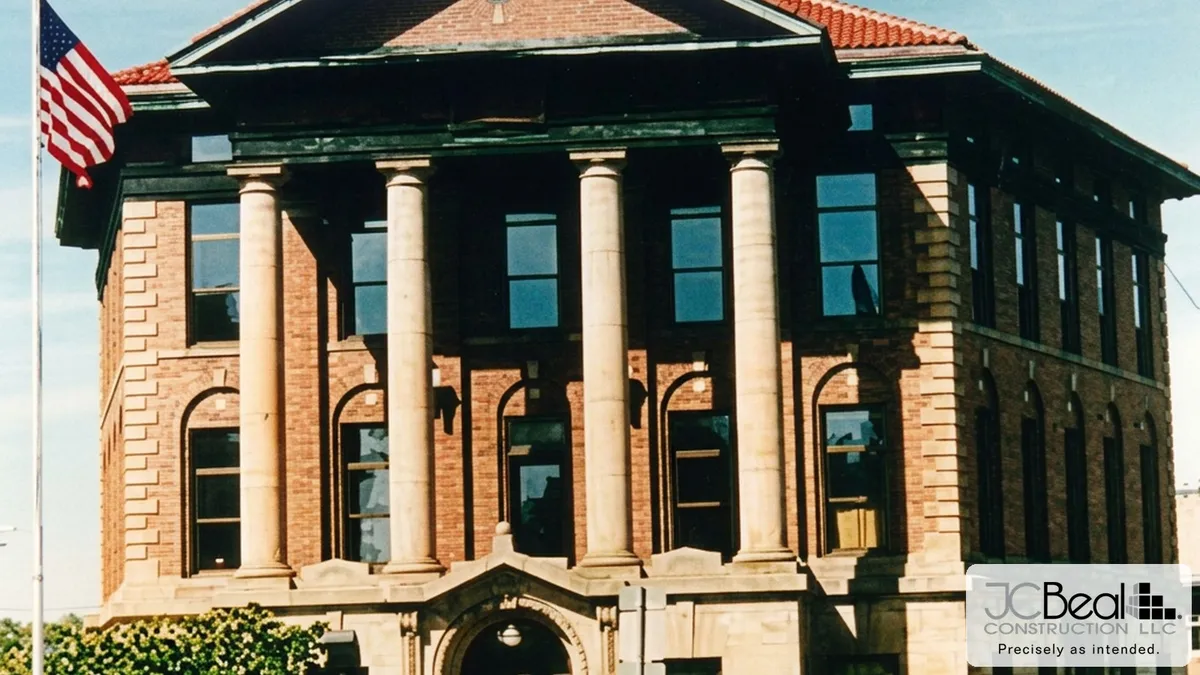
Restoring Hillsdale City Hall: What It Takes to Rebuild a Civic Landmark Precisely as Intended
When a city hall burns, floods, or simply succumbs to a century of deferred maintenance, a community loses more than office space. It loses the building where marriages were licensed, businesses were chartered, and generations of local decisions were made. Restoring a civic landmark is therefore a different kind of construction project — one where the goal is not to build something new, but to return something beloved, precisely as intended.
JC Beal Construction's restoration of Hillsdale City Hall in Michigan is a working example of what that standard demands. Here is what actually goes into rebuilding a civic landmark, and what institutions and building owners should understand before undertaking one.
Restoration Begins with Investigation, Not Demolition
A civic building that has stood for a hundred years holds a hundred years of undocumented changes: partitions added in the 1950s, mechanical systems threaded through structure in the 1970s, water intrusion quietly working on masonry the entire time. Before any meaningful restoration plan can be priced, the building must be understood.
That means a thorough existing-conditions assessment: probing plaster to find original finishes, opening ceilings to map the true framing, testing mortar composition so repairs bond correctly, and documenting every profile — window casings, cornices, balustrades — that must be preserved or recreated. Skipping this phase does not save money. It simply relocates the cost into change orders, discovered one surprise at a time.
The Craft Problem: Materials and Trades That Are No Longer Common
The materials in a historic city hall were often produced by methods that no longer exist commercially. Bricks were fired differently and vary in size and color. Plaster was applied in multi-coat systems over lath by tradespeople who did it every day. Millwork was cut from old-growth lumber with profiles no lumberyard stocks.
Faithful restoration means solving each of these puzzles honestly:
- Masonry: matching brick and mortar not just in color but in hardness — modern portland-cement mortar can actually damage soft historic brick, so restoration masons use softer lime-based blends matched to the original.
- Plaster and finishes: repairing rather than replacing where possible, and recreating original textures and profiles where damage is too far gone.
- Millwork and metals: custom-milling trim to match documented profiles, and restoring original wood and steel windows instead of defaulting to replacement.
This is why restoration work is as much craft management as construction management: the schedule depends on trades — restoration masons, plasterers, millwork shops — that must be sourced, vetted, and sequenced with care.
Modern Function Inside a Historic Shell
A restored city hall cannot merely look like 1910 — it has to work like today. That means modern electrical, data, fire suppression, and HVAC (heating, ventilation, and air conditioning) systems integrated into a building that was never designed for any of them, along with accessibility upgrades required by the ADA (Americans with Disabilities Act): ramps, elevators, and accessible restrooms that serve every resident who walks in.
The discipline lies in routing all of that invisibly — chases hidden in closets and wall cavities, ductwork tucked above restored ceilings, modern life-safety systems placed so the historic character remains the first thing a visitor sees. Every routing decision is a small negotiation between code, function, and preservation, and it is where an experienced restoration general contractor earns their role.
Why Communities Make the Investment
A restored civic landmark returns value in ways a spreadsheet only partially captures. It anchors a downtown block and signals confidence to the private investment around it. It preserves embodied craftsmanship that could not be affordably replicated new. And for institutions, restoration frequently pencils better than expected once the alternatives — demolition, disposal, new construction, and the loss of community goodwill — are honestly priced against it.
Hillsdale City Hall is the version of this story we point to because it captures the standard that matters in civic work: the community should get back the building they remember, functioning better than it ever did — precisely as intended.
Planning a Restoration Project?
If your institution or municipality is weighing the restoration of a historic building — whether the challenge is fire damage, water intrusion, or a century of wear — the earliest conversations are the most valuable ones. JC Beal Construction brings decades of historic restoration experience across Michigan and Ohio, from civic landmarks to commercial anchors.
Connect with our team to talk through your building, your timeline, and what it will take to bring it back precisely as intended.