
Water Damage After the Fire: Why Suppression Water Often Causes More Loss Than the Flames
When a fire is finally knocked down, the relief on a property owner's face usually lasts about a day. Then the real assessment starts, and the same question comes up on nearly every commercial loss we walk: the fire only reached two floors — why is the whole building unusable?
The answer is almost always water. On a large share of commercial and institutional fire losses, the water used to extinguish the fire touches far more of the building than the flames ever did, and it keeps causing damage long after the last engine pulls away. Understanding that dynamic — before you ever need it — changes how quickly you respond and how much of your building you keep.
The volume problem: how much water a suppression operation actually puts inside a building
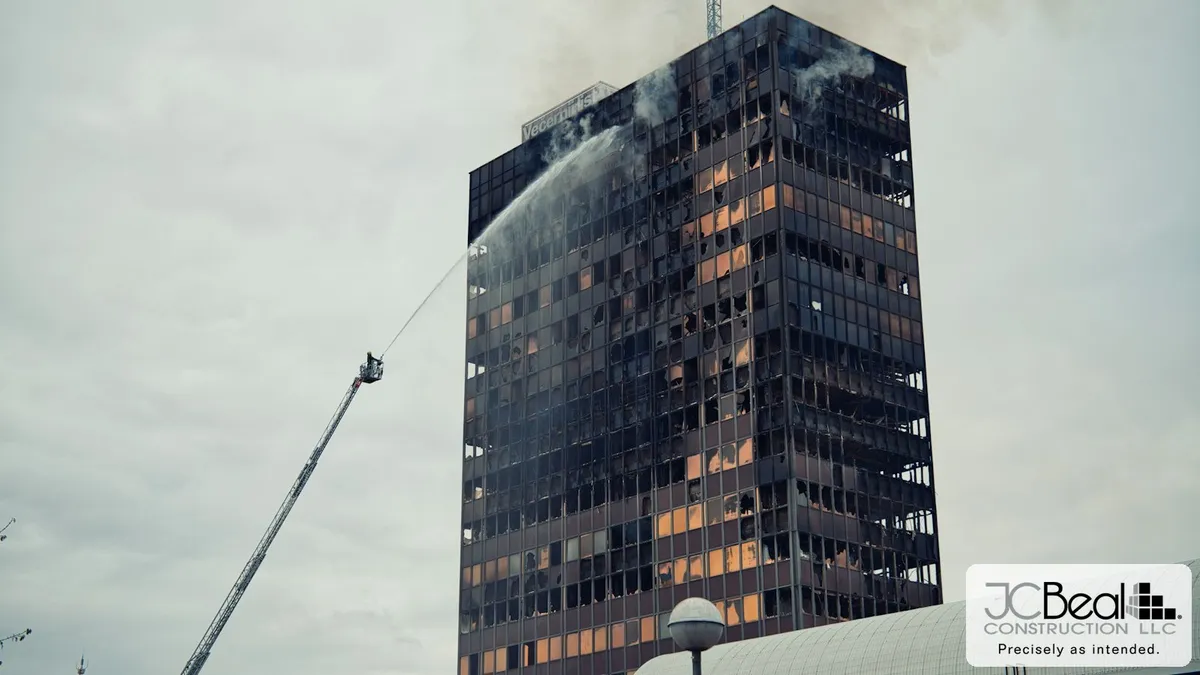
Firefighting is a volume business. A single 1¾-inch handline — the standard attack hose crews pull off an engine — typically flows 150 to 180 GPM (gallons per minute). A 2½-inch line or a ladder-mounted master stream, like the one used on a multi-story facade, can move 250 to more than 1,000 GPM. Automatic sprinkler heads add roughly 20 to 30 GPM each, and once several activate, they run until someone physically closes the valve.
Run the arithmetic on a moderate commercial fire. Two handlines operating for 45 minutes is somewhere in the neighborhood of 15,000 gallons. That is well over 100,000 pounds of water introduced into a structure that was engineered to hold furniture and people, not a small reservoir. None of it stays where it lands.
Water goes everywhere the fire did not
Flames travel upward and outward along fuel. Water travels downward along gravity, and gravity has access to parts of your building that fire never reached. In the hours after suppression, water is moving through:
- Floor assemblies — through penetrations, seams, and stairwells into every level below the fire floor.
- Wall cavities — soaking insulation, framing, and the back side of finishes where nothing is visible from the room side.
- Elevator shafts and pits — where standing water reaches controllers, wiring, and pit equipment, and often takes the elevator out of service for weeks.
- Basements and lower levels — collecting where the mechanical rooms, electrical service, records storage, and inventory usually live.
- MEP systems — the mechanical, electrical, and plumbing systems that run the building. Saturated electrical equipment, ductwork, and controls frequently cannot simply be dried and returned to service; a great deal of it has to be replaced.
This is why a third-floor fire in a five-story building routinely produces damage on floors one through three, in the basement, and in systems that serve the entire property. The fire damage has a boundary. The water damage does not.
The clock that starts when the fire goes out
Suppression water does not stay clean, and it does not stay harmless. The restoration industry classifies water by contamination level, following the standard published by the IICRC (the Institute of Inspection, Cleaning and Restoration Certification), which sets the widely accepted practices for water damage remediation:
- Category 1 — clean water from a sanitary source.
- Category 2 — water carrying significant contamination that can cause illness.
- Category 3 — grossly contaminated water.
Water that has run through a fire scene rarely starts at Category 1. It has already picked up soot, ash, char, and the chemical residue of burned building materials and contents. More to the point, water degrades from one category to the next as it sits — generally within 24 to 48 hours. Materials that could have been dried and saved on day one become materials that must be removed and replaced by day three.
Microbial growth runs on a similar schedule. Under the warm, still, humid conditions inside a closed-up building after a fire, mold can begin establishing itself in porous materials within 24 to 72 hours. At that point you are no longer managing a fire loss. You are managing a fire loss, a water loss, and an indoor air quality problem, each with its own scope, its own cost, and its own liability exposure.
Why historic and institutional buildings lose more
The buildings we work on across Detroit and Toledo — century-old commercial structures, institutional campuses, downtown properties in the middle of redevelopment — are more vulnerable to suppression water than modern construction, for reasons built into how they were made.
Traditional lime and gypsum plaster over wood or metal lath absorbs water readily and loses its key — the mechanical grip that holds plaster to the lath — as it saturates. Ceilings that survived the fire intact come down days later. Original millwork, ornamental trim, and hardwood flooring swell, cup, and separate at the joints. Old-growth structural timber holds moisture deep in the section, well past the point where a surface reading suggests it is dry. Masonry wicks water through mortar joints and can carry it laterally into areas nowhere near the fire.
These are also the materials that cannot be reordered. A modern building loses drywall and carpet, and both are replaceable commodities. A historic building loses the ornamental plaster cornice and the original casework that give the property its designation, its character, and in many cases its tax credit eligibility. Every hour those materials sit wet is an hour of the building's history you may not get back.
What owners should be doing in the first hours
Once the fire department releases the property, the highest-value work is not cleanup. It is stopping the water damage from progressing and documenting it correctly for the claim.
- Get standing water out immediately. Extraction is the single highest-return action in the first 24 hours, and its value declines by the hour.
- Stabilize and dry the structure. Board-up, roof tarping, temporary power, controlled heat, dehumidification, and air movement — before the building sits closed up and humid over a weekend.
- Document moisture, not just damage. Moisture meter readings, thermal imaging, and dated photographs establish the true extent of the loss. Water damage inside a wall cavity is invisible in a walkthrough and easy to leave out of an initial scope.
- Separate salvageable from non-salvageable early. On historic properties, this is a restoration judgment, not a demolition decision, and making it too fast destroys material that could have been saved.
- Get the full scope into the claim from the start. Insurance adjusters work from the scope they are given. A scope written around visible fire damage, with water damage discovered later, produces supplemental claims, delays, and disputes — usually at the owner's expense.
The scope you write in week one determines the building you get back
The most expensive mistake we see after a commercial fire is not a bad repair. It is an incomplete assessment: a scope that captures what burned and misses what got wet. Six weeks later, the plaster is failing, the subfloor is cupping, the elevator will not pass inspection, and there is microbial growth behind a wall nobody opened. The work gets done twice, the claim gets reopened, and the building sits unoccupied through both.
Fire and water damage restoration is one discipline, not two, and on a historic or institutional property it also has to be a preservation discipline. Getting it right means treating suppression water as a primary loss from the first hour — assessing it fully, drying aggressively, and rebuilding what was damaged precisely as intended.
If you own or manage a commercial, institutional, or multifamily property and want to understand your exposure before an incident — or you are working through a loss right now — connect with our team.