
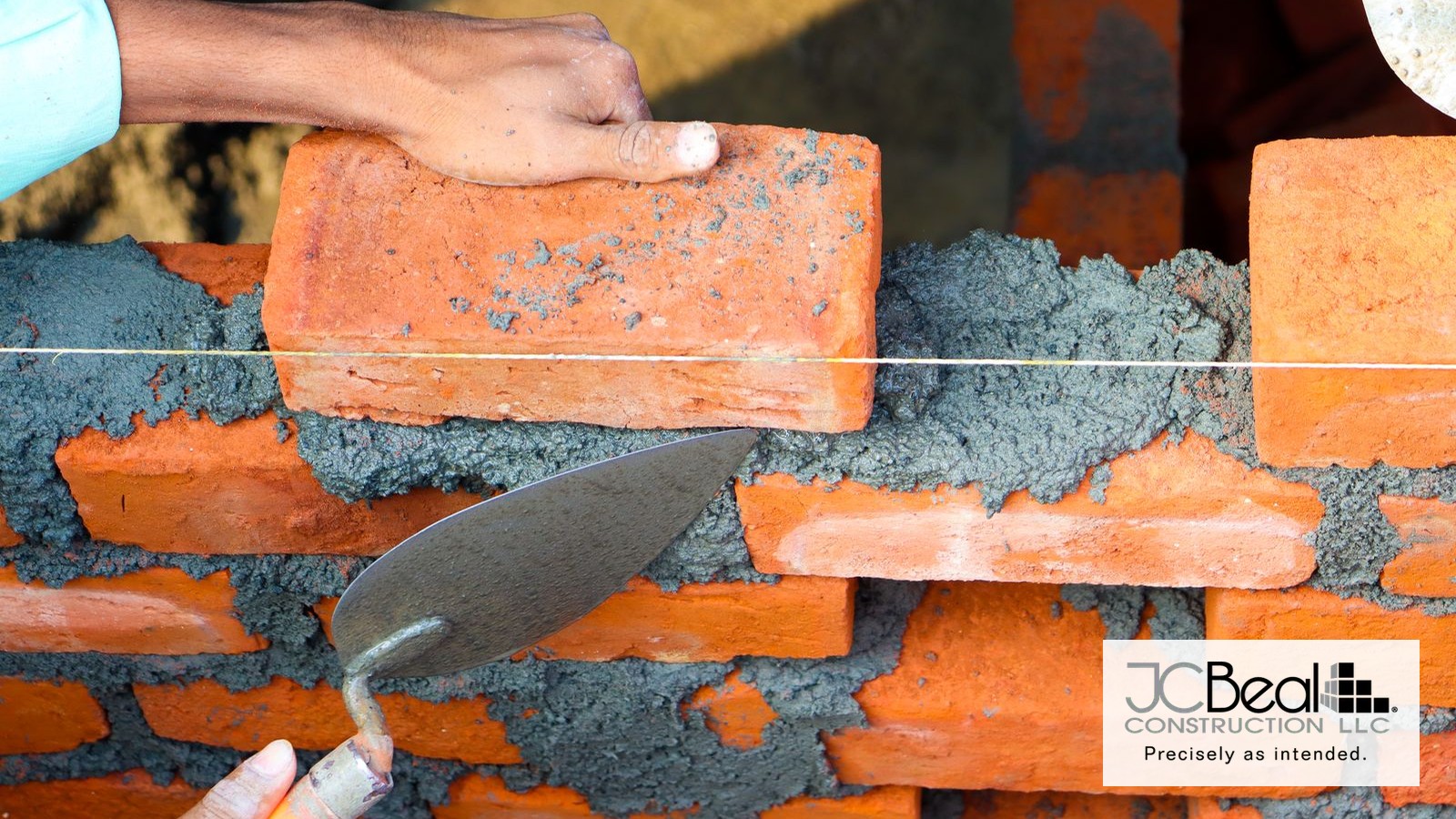
Why Matching 1920s Masonry Is Harder Than Building New: Inside the Craft of Historic Brick Restoration
A building owner looks at a damaged section of 1920s brick wall and reaches a reasonable conclusion: it is brick. Brick is a commodity. Replace the broken units, tuck in some mortar, and move on.
Then the bid arrives, and the masonry restoration line is several times what new masonry would cost for the same square footage. The instinct is to assume someone is padding the number.
They usually are not. Matching century-old masonry is a materials science problem wearing a construction hat, and almost everything that makes new brickwork fast makes restoration slow. Understanding why protects your budget, your schedule, and — in a designated historic building — your eligibility for the tax credits that often make the project work at all.
The brick itself is a different material
Brick made in the 1920s and earlier was typically fired at lower and less uniform temperatures than modern brick. The result is a unit that is softer, more porous, and more variable — sometimes within the same wall, because early kilns produced a range of hardness depending on where a brick sat during firing.
That softness is not a defect. It is central to how the wall works. Historic masonry walls were designed to absorb moisture and release it again, using the brick and mortar together as a system that breathes. Modern brick is denser and far less absorbent, because modern walls handle water differently — with cavities, flashing, weeps, and water-resistive barriers that did not exist a century ago.
Drop a hard modern brick into a soft historic wall and you have introduced a rigid, non-absorbent unit into an assembly that expects the opposite. Water that would have moved through and evaporated now concentrates around the new unit. In a Michigan or Ohio freeze-thaw cycle, concentrated moisture is how masonry fails.
The mortar problem is the expensive one
If there is one decision that separates competent restoration from damage disguised as repair, it is mortar selection.
Historic walls were laid with lime-based mortar. Lime mortar is intentionally softer than the brick around it. That matters because a masonry wall moves — it expands, contracts, settles, and takes on load. Something has to absorb that movement. In a properly built historic wall, the mortar does. Mortar cracks, mortar crumbles, and mortar gets replaced on a maintenance cycle. The brick survives.
Modern Portland cement mortar is much harder and much less permeable. Repoint a soft historic wall with a hard cement mortar and you reverse the relationship: now the mortar is stronger than the brick. When the wall moves, the mortar does not yield, so the stress goes into the brick instead. When water gets in and cannot escape through the joint, it exits through the face of the brick — and in a freeze, it takes that face with it.
This failure mode is called spalling: the outer surface of the brick pops off, exposing the softer interior, which then deteriorates much faster. It typically shows up three to ten years after the repointing job that caused it, long after the contractor who did the work is gone.
This is why the National Park Service — the federal agency that administers the standards governing historic rehabilitation — is explicit that replacement mortar should match the original in strength, composition, color, and texture, and should never be harder than the surrounding masonry. It is also why responsible restoration work begins with mortar analysis: a laboratory examination of original mortar samples to determine the binder-to-aggregate ratio and the sand's color and particle size, so the replacement can be formulated to match rather than guessed at.
Repointing is a craft operation, not a production one
Repointing — sometimes called tuckpointing — means removing deteriorated mortar from the joints and replacing it. In new construction, joints are struck once as the wall goes up and the work moves at the speed of the mason. In restoration, each step is deliberate:
- Removal depth. Old mortar is cut out to roughly two to two and a half times the joint width, deep enough for the new mortar to hold but not so deep as to disturb the wall's interior.
- Removal method. On soft historic brick, power grinders are used sparingly if at all. A grinder that wanders a sixteenth of an inch takes an irreplaceable brick arris — the crisp edge of the unit — with it. Much of the work is done by hand with chisels, which is slower by an order of magnitude.
- Joint profile. The finished shape of the joint is a design element. Concave, weathered, raked, grapevine, and beaded joints each read differently on a facade, and each sheds water differently. The new work has to reproduce the original tooling, which means the mason is matching a hand technique, not a specification.
- Curing. Lime-based mortars cure slowly and require controlled moisture. That means misting schedules, protective coverings, and temperature limits — real constraints on a Great Lakes construction calendar.
Finding brick that actually matches
When units genuinely must be replaced, matching them means reconciling five variables at once: size, color, texture, absorption rate, and compressive strength.
Historic brick dimensions were not standardized the way modern brick is, and a difference of a quarter inch in height compounds across a wall until courses no longer line up with adjacent original work. Color is rarely one color — a historic facade is usually a blend, and matching it means matching the blend, not the average.
Three sourcing paths exist, in rough order of preference:
- Salvage from the building itself. The best match is brick that came out of a less visible elevation — a rear wall, a light well, an area being altered anyway — and gets relocated to the primary facade. The concealed area then receives the modern replacement.
- Reclaimed brick from the same era and region. Salvage yards in Detroit and Toledo carry stock from demolished buildings of the same period, often from the same regional clay sources. Quantities are limited and inconsistent, so this path requires early ordering.
- Custom-manufactured replicas. Several manufacturers will produce brick to a specified size, color range, and texture. Quality is excellent and lead times are long — frequently several months, which makes this a design-phase decision rather than a field decision.
On any of these paths, the answer is settled with a mock-up panel: a small sample section of the actual wall, built with the proposed brick and mortar, cured, and evaluated in daylight from the distance the public will see it. Photographs and small samples routinely mislead. A cured panel on the building does not.
What this means for approvals and tax credits
If the building is listed on the National Register of Historic Places, or is pursuing federal or state historic tax credits, the masonry approach is not just a technical matter — it is a compliance matter. Work must meet the Secretary of the Interior's Standards for Rehabilitation, and the reviewing authority is typically the State Historic Preservation Office, or SHPO, in Michigan or Ohio.
Mortar composition, removal method, joint profile, and replacement unit selection are all reviewable decisions. A repointing approach chosen in the field without documentation can jeopardize a credit worth a substantial share of project cost. We cover the framework in more depth in our guides to the Secretary of the Interior's Standards and how historic tax credits work in Michigan and Ohio.
How to read a masonry restoration bid
When you compare proposals, the low number is often low because it left something out. Ask every bidder:
- Will you perform mortar analysis, and will the replacement mortar be softer than the existing brick?
- What is your joint removal method, and where will grinders be used?
- What joint profile will you reproduce, and how did you determine it?
- Where will replacement brick come from, and what is the lead time?
- Will you build a mock-up panel for approval before full production begins?
- How will the work be protected and cured given the season it will be performed in?
A bid that cannot answer these is not cheaper. It is a repair with a shorter life and a repair bill attached to it — one that arrives after the warranty has expired and usually costs more than doing it correctly the first time. That principle runs through every century-old building we restore, and it is what we mean when we say precisely as intended.
Why the craft is worth the cost
A masonry facade is the part of a historic building the public actually experiences. It is the reason a downtown block reads as a place with a history rather than a collection of aging structures, and it is a meaningful share of why restored anchor buildings change the economics of a street. Done correctly, repointing has a service life measured in many decades. Done incorrectly, it accelerates the loss of original material that cannot be replaced at any price.
The premium you are paying is not for brick. It is for the analysis, the sourcing, the hand work, and the judgment that keeps a hundred-year-old wall standing for another hundred. The same discipline shows up across the landmark projects reshaping Detroit and Toledo and in civic work like the restoration of Hillsdale City Hall.
Have a masonry question on a historic property?
Whether you are evaluating a facade, comparing restoration bids, or planning a rehabilitation that needs to satisfy a preservation review, we are glad to walk through the options with you.
Connect with our team to get started.