
Building Through a Michigan Winter: Temporary Enclosures, Cold-Weather Masonry, and Keeping an Open Envelope on Schedule
In Michigan and Ohio, winter is not a pause button — it is a planning problem. A historic restoration project with an open building envelope (the exterior walls, roof, and windows separating conditioned interior space from the outdoors) is vulnerable to freeze-thaw damage, water intrusion, and mortar failure if the wrong work happens at the wrong temperature. That doesn't mean shutting down from November to April. It means building differently for a few months, with the right protection, materials, and sequence.
Why an Open Envelope Is the Real Risk in Winter
Most historic restoration work opens up the building envelope at some point — removing deteriorated brick for repointing, taking out a window for restoration, or exposing a roof deck during re-flashing. In summer, that is an inconvenience. In a Michigan winter, it is a liability: cold air infiltration can freeze standing water inside wall cavities, damage interior finishes under protection, and keep adhesives, sealants, and coatings from curing properly.
That is why the first conversation on any winter restoration schedule is about exposure, not aesthetics: how much of the exterior will be open at any given time, for how long, and what happens if a storm rolls through before that section closes back up. We took this approach on the window restoration work covered in our recent post on repairing original windows instead of replacing them — removing one sash at a time, rather than an entire elevation, keeps the envelope substantially intact throughout the job.
Temporary Enclosures: Buying a Controlled Environment
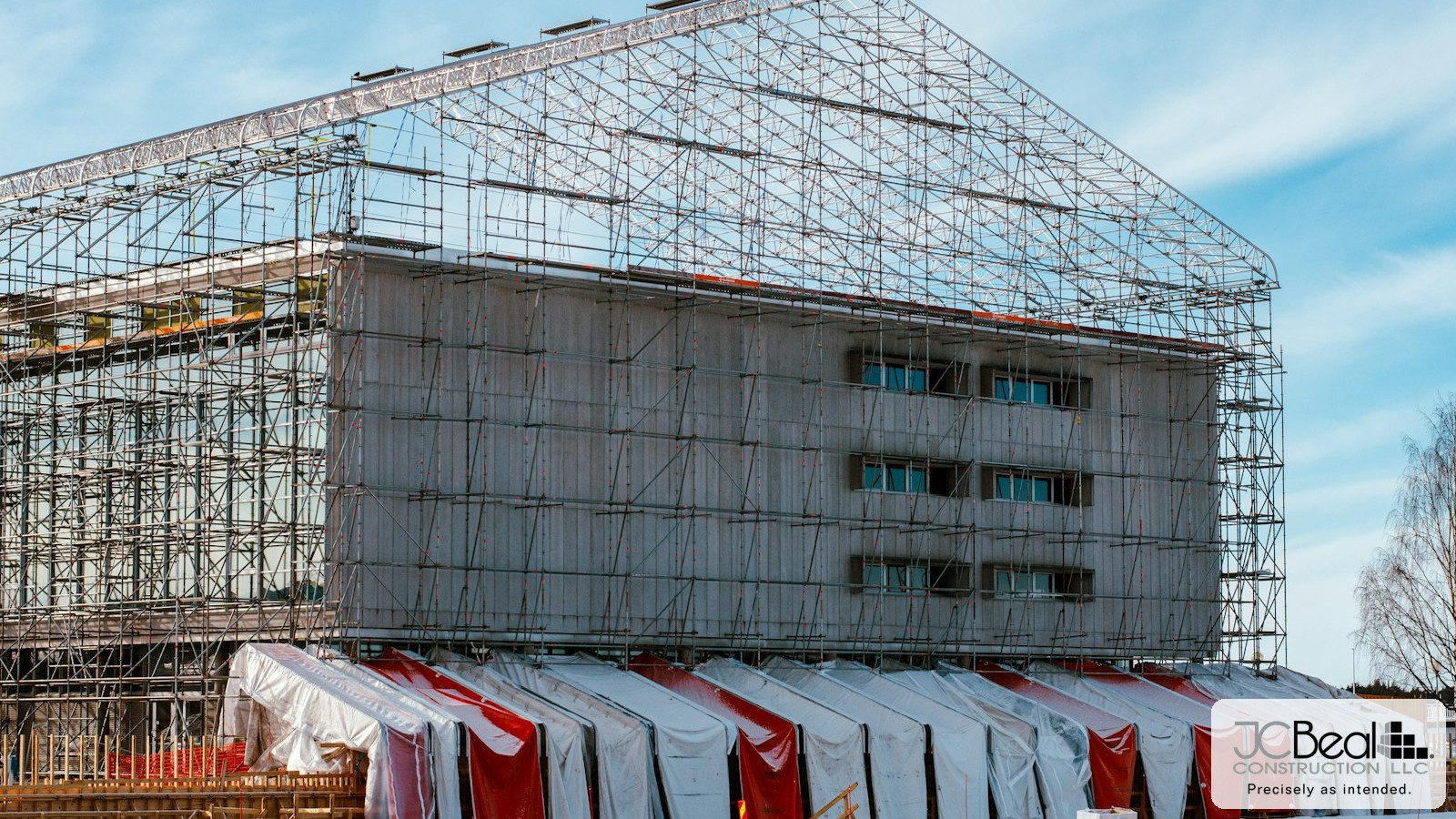
The primary tool for winter restoration is the temporary enclosure — a framed and tarped or shrink-wrapped structure built around scaffolding that turns an exposed exterior work zone into a semi-conditioned space. A good enclosure keeps precipitation and wind off the work surface, lets heaters bring the immediate area up to a workable temperature, and holds that temperature long enough for mortar, sealants, or coatings to cure on schedule rather than on the weather's schedule.
Enclosures are not free, and they are not automatic. Sizing one correctly means balancing the square footage of exposed wall against available heating capacity, the elevation's wind exposure, and how long that section needs to stay open. On a downtown high-rise, an enclosure wrapping an upper floor has to account for wind loading on the structure itself — engineered work, not plastic sheeting stapled to scaffold frames. The cost belongs in the budget from the earliest planning stages, not as a change order discovered in December.
Cold-Weather Masonry: Keeping Mortar Alive Below Freezing
Mortar is a chemical process, not just a paste. Portland cement mortar cures through hydration — a reaction between cement and water that generates its own heat but stops almost entirely below about 40 degrees Fahrenheit and can be permanently damaged if the mix freezes before it sets. That single fact drives most of the technique behind cold-weather masonry.
A few practices are standard on a well-run winter masonry job:
- Admixtures. Accelerating admixtures speed up the hydration reaction so mortar reaches safe strength faster, shrinking the window in which it is vulnerable to freezing. These go in at carefully controlled ratios — too much accelerator affects long-term strength and appearance, which matters when the mortar has to match century-old material, a challenge we detailed in our piece on matching 1920s masonry.
- Ground and material thawing. Frozen brick, block, or stone pulls heat out of fresh mortar on contact, defeating even a heated enclosure, so materials are staged inside heated space and any frost on the substrate is thawed before new mortar goes on.
- Heated water and sand. Mixing water is warmed and aggregate kept above freezing, so the mortar starts its life at a workable temperature instead of losing heat to cold materials.
- Curing protection. Fresh joints are covered with insulating blankets after tooling, sometimes paired with ground heaters or radiant heat, to hold curing temperature through the 48 to 72 hours that matter most.
- Temperature monitoring. Data loggers or regular manual checks record the work zone's temperature, creating a record that the work met code and manufacturer requirements — documentation that matters if a question comes up about a joint's performance years later.
None of this is exotic; it is standard practice for masons who work in the Great Lakes region year-round. The difference on a historic restoration project is that the mix, tooling, and finish also have to match 1920s or 1930s material — cold-weather technique and historic accuracy have to be solved together.
Sequencing the Schedule Around the Weather
The least expensive way to manage winter is to not fight it where you don't have to. A general contractor sequencing a winter schedule generally moves exterior masonry, roofing, and envelope work into the enclosed, heated phase deliberately, while pushing interior finishes, mechanical rough-in, and millwork into the months when heat and enclosures are least practical to sustain. On an institutional or commercial project with a board watching both schedule and budget, that sequencing decision is often the single biggest lever for controlling cost.
Weather-driven delays compound: a week lost to an ice storm on the masonry crew pushes back the point at which the building is watertight, which pushes back interior trades, which pushes back occupancy. Building float into the schedule around known weather-sensitive activities, with a realistic fallback when a specific week is worse than forecast, is what keeps a winter restoration on budget instead of generating a string of change orders. It is the same logic that governs phasing on occupied buildings, discussed further in our post on phased construction in occupied buildings: sequence the work so the building's most vulnerable moments are also its shortest.
For an owner or facilities director evaluating a winter restoration bid, the enclosure and cold-weather masonry plan is worth asking about directly. A contractor who can walk through exactly how the envelope stays protected, how mortar stays above its cure threshold, and how the schedule accounts for a bad week in January has done this before.
Building Precisely as Intended, Regardless of Season
Winter changes the methods, not the standard. A restoration project that runs through a Michigan winter should come out the other side with masonry, envelope details, and finishes indistinguishable from work done in July — protected by the right enclosure, cured under the right conditions, and sequenced so the building's most vulnerable moments were also its shortest.
If you're planning a restoration or redevelopment project that will run through the winter months, connect with our team to talk through enclosure strategy, cold-weather masonry planning, and a schedule built around Michigan and Ohio's weather rather than in spite of it.