
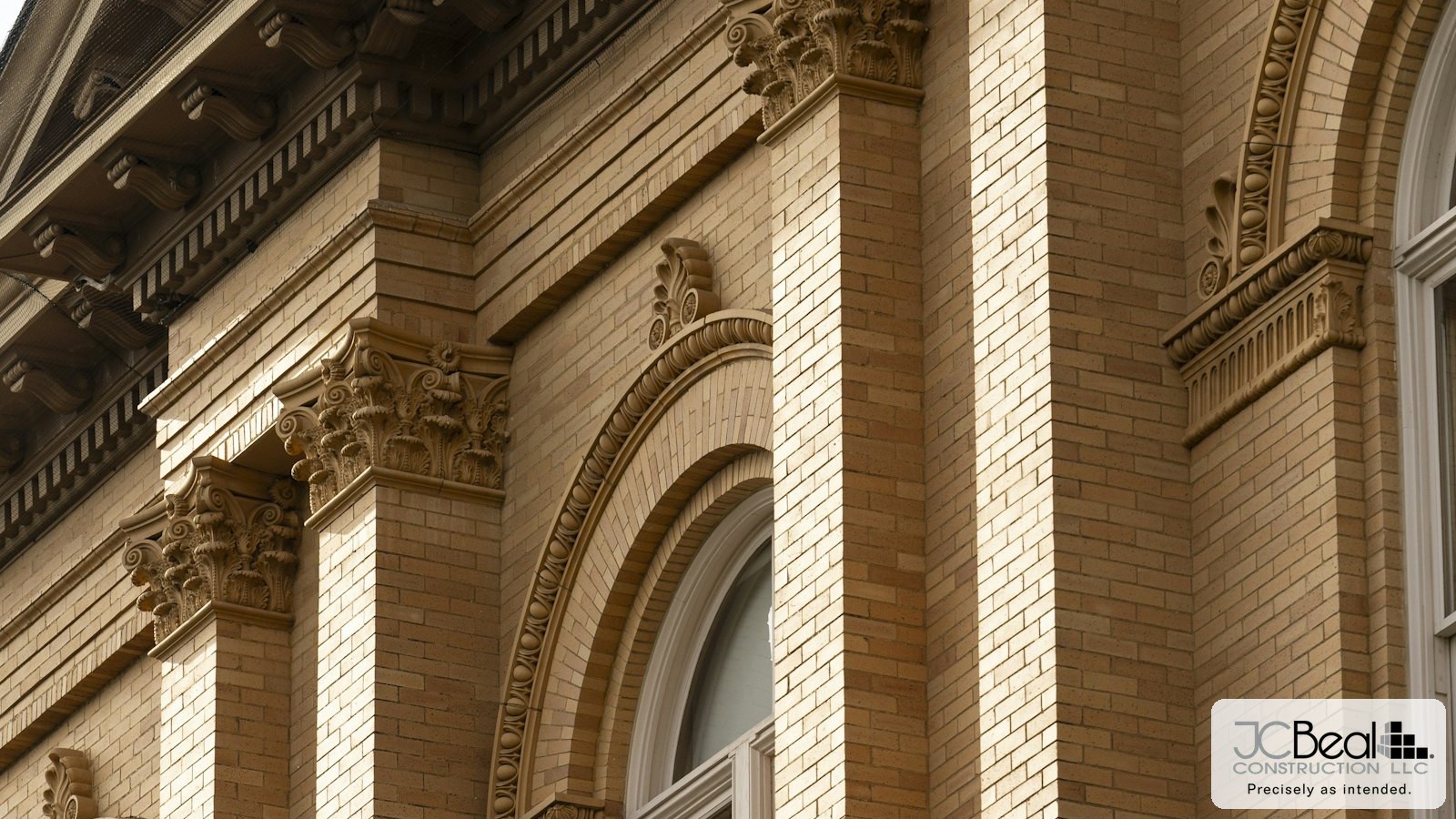
Preserve or Replicate? When Original Material Can Be Saved and When Replication Is the Honest Choice
Every restoration project reaches the same moment. A contractor stands in front of a damaged cornice, a rotted window sash, or a section of terra cotta that's spalling off the façade, and someone has to answer a deceptively simple question: do we save this, or do we replace it? The answer shapes the budget, the schedule, and — more than either of those — whether the finished building still tells the truth about its own history.
At JC Beal Construction, we've spent decades working through that question on landmark buildings across Detroit and Toledo, and the honest answer is almost never a blanket rule. It's a material-by-material, detail-by-detail evaluation. Getting it right is the difference between a restoration that reads as authentic and one that reads as a movie set.
The Case for Preservation First
The Secretary of the Interior's Standards for Rehabilitation — the federal framework that governs most tax-credit and historically designated work — start from a clear presumption: repair before replace. We've written before about what those standards actually require of building owners, but the short version is this: original material carries information a reproduction can't. The tool marks on hand-carved limestone, the slight irregularity of century-old brick, the specific alloy in a bronze storefront — these are physical evidence of how and when a building was made. Once they're gone, they're gone for good.
Preservation is also, in a lot of cases, the more durable choice. Old-growth wood window sashes, for example, are frequently sounder than anything available new. A sash with failed glazing putty and peeling paint looks like a demolition candidate to an untrained eye, but the wood itself may have another hundred years in it once it's stripped, consolidated, and reglazed. Replacing it with a vinyl or aluminum-clad unit trades a repairable asset for a disposable one.
When Replication Is the Honest Choice
But preservation isn't a moral absolute, and pretending otherwise does building owners a disservice. Some material simply can't be saved. Terra cotta with delaminating glaze and internal corrosion in its steel anchors is a genuine safety hazard — no amount of patching keeps it attached to the wall. Masonry that has absorbed decades of water intrusion can lose so much structural integrity that repointing alone won't stop the deterioration. Fire and water damage, the kind of loss our insurance-driven clients call us in for, can compromise material well past the point where in-kind repair is realistic.
In those cases, faithful replication is the honest path — replacing the failed element with new material that matches the original in profile, texture, and finish, so the building's design intent survives even though the physical fabric is new. The dishonest version of replication is the one that cuts corners: a flattened cornice profile, a synthetic stone that reads as plastic under raking light, a substitute brick that's close enough from the sidewalk but wrong up close. Boards, insurers, and preservation review bodies notice the difference, and so do the tenants and visitors who use the building for the next fifty years.
How We Make the Call
On every restoration project, our team runs a material-by-material assessment before a single piece comes off the building: probing masonry for soundness, testing paint and coatings, evaluating structural steel and anchors behind terra cotta and stone, and documenting original profiles and finishes so any necessary replication is dimensionally exact. We wrote in detail about why matching century-old masonry is harder than building new — the short answer is that brick color, mortar composition, and joint tooling all have to be reverse-engineered from surviving fabric before a single new unit gets ordered. We've also covered the discovery risk baked into that process — the lead, asbestos, and unknown framing conditions that can turn a straightforward repair into a redesign mid-project.
That assessment work is where preserve-or-replicate decisions actually get made — not in a boardroom, but on scaffolding, with a contractor who knows what a sound joint feels like under a probe and what a compromised anchor sounds like under a hammer tap.
Precisely as Intended, on Real Buildings
Our restoration of Hillsdale City Hall required exactly this kind of triage across the building's masonry, windows, and civic detailing — some elements repaired in place, others faithfully replicated where deterioration had gone too far to reverse. At Canham, the same discipline applied to a very different building type and set of materials, and our work on HFHospital shows what that assessment looks like on an occupied institutional building, where the stakes for getting the call right are even higher.
This is also central to the downtown revitalization work we take on across Detroit and Toledo — anchor buildings that have sat vacant or underused for years often need both approaches on the same façade, and the right mix is what determines whether the finished project reads as a genuine restoration or an obvious rebuild.
Talk to Us Before You Decide
If you're an owner, board member, or insurance-side stakeholder facing this decision on your own building — whether it's storm damage, fire loss, or simply decades of deferred maintenance catching up with a landmark structure — the assessment should come before the budget, not after. We'll walk the building with you, document what's salvageable, and give you a straight answer on what can be preserved and what has to be replicated, precisely as intended.
Connect with our team to schedule a walkthrough.